Have you ever encountered search results powered by AI that seem off or contain errors?
With Google’s AI-driven answers now appearing prominently at the top of search results, it’s easier than ever to receive instant answers. But even though these answers seem confident and precise, they can occasionally be incorrect or outdated. While AI is designed to provide convenience, speed doesn’t always ensure accuracy. At times, AI can oversimplify complex matters, rely on outdated sources, or misinterpret the data. In today’s world, understanding when to trust AI-generated answers and when to verify them is an important digital skill.
Why Do AI Search Answers Appear So Reliable?
AI search results are designed to save time by providing quick, easy-to-understand answers, pulling data from multiple sources. In digital marketing, this speed and efficiency help users find relevant content faster, avoiding information overload.
Several psychological reasons make these summaries seem trustworthy. By understanding AI search optimization, you can navigate search results more effectively and find the most accurate information with ease.
- Clarity instills trust: Short, straightforward answers often appear authoritative.
- Speed builds reliability: Instant answers make users feel more confident in the result.
- Authority bias: Information placed at the top of results is perceived as official.
- Convenience reduces questioning: Users are less likely to question answers that are quick and easy.
However, these psychological factors can lead to users accepting AI-generated summaries without checking their sources, even when deeper verification is needed.
User Insights on AI Search Accuracy
A Reddit thread highlights users’ concerns over AI-generated summaries, emphasizing that while these answers often sound authoritative, they can be misleading. Users are becoming more aware that AI search should be treated as an initial guide rather than the final answer.
Where AI Can Go Wrong
Although AI search is constantly improving, it’s still not perfect. Here are some common pitfalls where AI-generated answers can be misleading:
- Outdated data: The information provided might not be current.
- Oversimplified complex topics: Important nuances might be left out.
- Lack of context in statistics: Figures might be presented without the proper background or explanation.
- Incorrect merging of conflicting sources: AI might incorrectly combine conflicting information.
- Limited data on emerging topics: AI struggles with newer or niche areas where reliable sources are scarce.
These flaws don’t necessarily mean AI answers are deliberately misleading, but they can result in incomplete or inaccurate information.
Why AI Search Can Make Mistakes
AI tools don’t truly “know” facts. Instead, they generate responses based on patterns learned from existing data, which means they’re prone to errors:
- Conflicting information: Online content can present opposing facts.
- Outdated data: Some AI models pull from old sources.
- Context misinterpretation: AI might misunderstand the context of a query.
- “Hallucinations”: AI can fabricate plausible-sounding, yet incorrect, information.
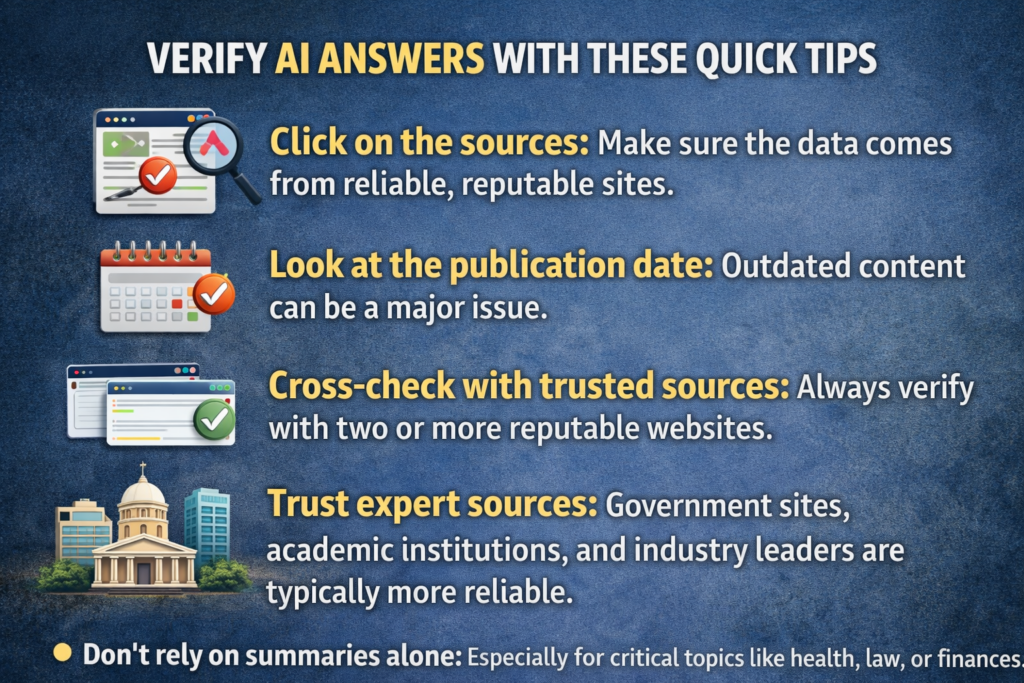
Think of AI as a powerful assistant, not a perfect source of knowledge.
The Future of AI Search and Digital Literacy
AI search is continuously evolving, but no technology can replace critical thinking. As AI becomes more integrated into our lives, the ability to quickly verify the information you receive will be just as vital as accessing it.
The goal isn’t to distrust AI, it’s to use it wisely. By combining the power of AI with human oversight, users can make more informed, accurate decisions in a world that’s becoming increasingly automated.